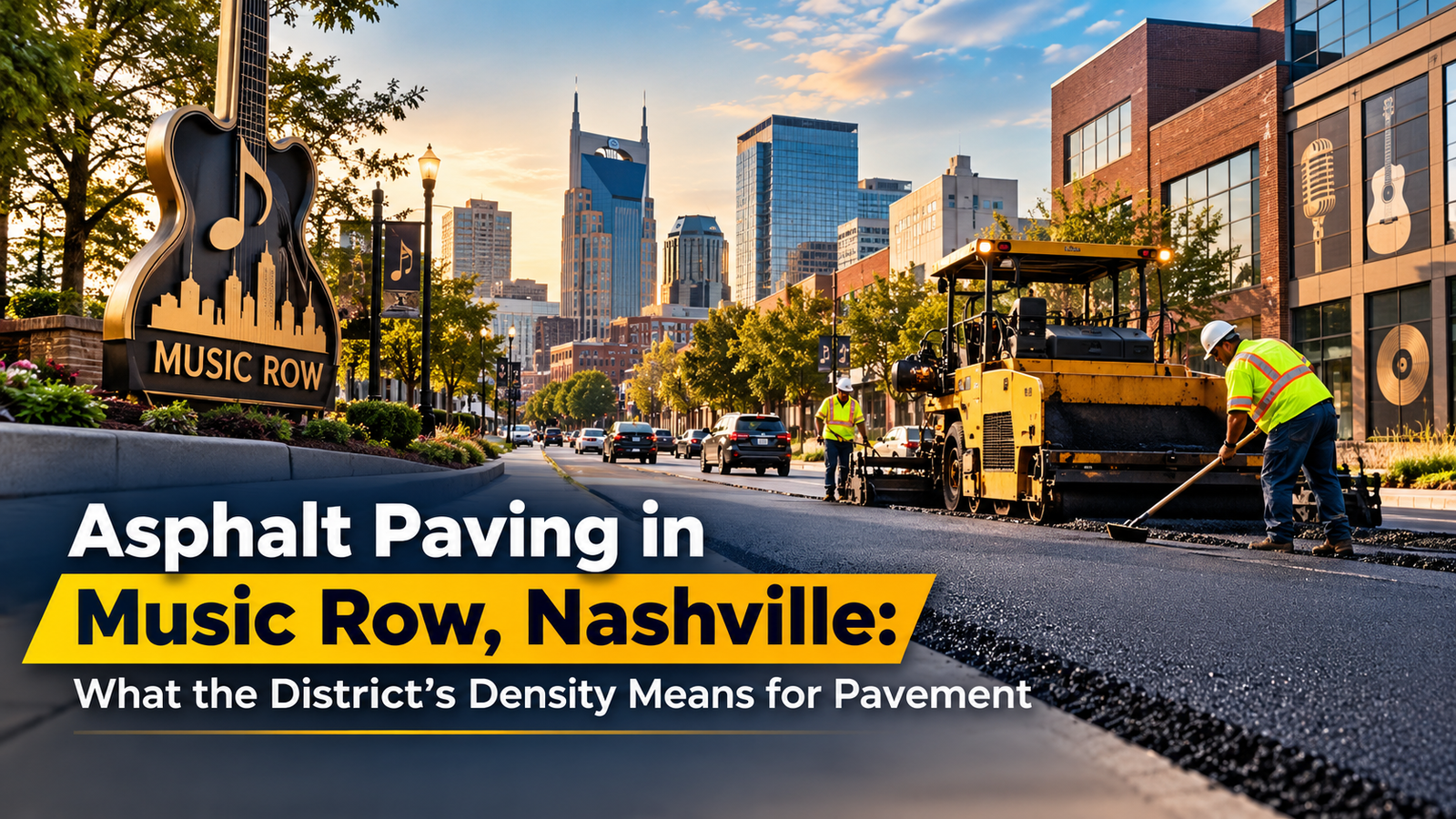
Music Row is the commercial and creative center of the American country music industry. The district occupies a compact area roughly bounded by Division Street, Demonbreun Street, 16th Avenue South, and the Edgehill neighborhood a dozen or so blocks where recording studios, publishing houses, management companies, label offices, and production facilities have clustered since the 1950s. The physical fabric of Music Row is dense, the lots are small, the streets are narrow, and the parking demands generated by a working music industry district create pavement conditions unlike any other part of Nashville.
Asphalt Contractor Music Row operates in this specific urban context. The pavement challenges here are shaped by Tennessee’s climate, Nashville’s geology, the district’s development density, and the particular traffic patterns of a commercial corridor where delivery vehicles, tour buses, industry professionals, and visitors all converge in a tight footprint. Understanding these conditions is the foundation for any serious discussion of pavement installation and maintenance in this part of the city.
Tennessee’s Climate and What It Does to Asphalt in Nashville
Nashville sits in the humid subtropical climate zone, with hot, humid summers and winters that are cold enough to generate freeze-thaw cycling but rarely cold enough to maintain sustained deep frost. The average annual temperature is approximately 59 degrees Fahrenheit, and winter days frequently oscillate around the freezing threshold the pattern most damaging to asphalt pavement because it generates the most frequent freeze-thaw cycles rather than prolonged cold.
The summer heat in Nashville is a pavement stress factor that distinguishes the city from colder northern markets. When pavement surface temperatures on a July afternoon exceed 140 degrees Fahrenheit a common occurrence on dark asphalt in full sun the asphalt binder softens. Under concentrated loads, soft binder can rut and deform. Parking lots and driveways that serve heavy vehicles are particularly vulnerable to this warm-weather rutting. Mix design accounts for this through the performance-graded binder specification: in the Nashville area, PG 76-22 binder is commonly specified for surface courses to maintain adequate stiffness at high pavement temperatures while preserving cold-temperature flexibility.
Tennessee experiences significant rainfall Nashville averages approximately 47 inches per year and the combination of frequent rain events with permeable cracked pavement drives moisture infiltration and accelerates freeze-thaw damage. Pavement in Music Row’s parking lots and access drives that goes unmaintained accumulates cracks that serve as moisture entry points through spring rains, summer thunderstorms, and fall precipitation before the winter freeze-thaw season.
Nashville’s Geology and the Music Row Subgrade
Nashville sits on the Nashville Dome, a broad geological structure where Ordovician limestones and dolostones rise to the surface and influence soils across the central basin. The residual soils derived from these carbonate rocks are characteristically reddish-brown, clay-bearing, and variable in depth. Clay content is a significant factor in pavement subgrade design because clay soils are subject to shrink-swell behavior expanding when wet and contracting when dry that causes differential movement beneath pavement sections.
In Music Row, decades of development have introduced fill materials of varying quality beneath many parking areas and driveways. Urban fill the accumulated detritus of building demolitions, utility trenching, and grading for previous development cycles is heterogeneous and unpredictable. Pre-paving investigation in Music Row should include soil probing to characterize fill depth and quality, because areas with deep or poor-quality fill require base designs that compensate for the weak subgrade bearing capacity.
Limestone karst features subsurface voids formed by chemical dissolution of carbonate rock are present in portions of Nashville. While karst-related sinkhole activity is more common in suburban areas with less disturbed geology, pavement settlement without obvious mechanical cause in Music Row should be evaluated for subsurface void development. Ground-penetrating radar surveys can identify subsurface anomalies before they manifest as pavement failures.
Parking Lot Design for Music Row’s Commercial Character
Music Row’s parking lots serve a commercial district with round-the-clock activity. Recording sessions run through the night. Events at the Country Music Hall of Fame and Museum bring high visitor volumes. Publishing offices and management companies maintain business-hours parking. This pattern of continuous use, varied vehicle types, and concentrated turning movements at lot entries and exits creates pavement wear patterns that a good maintenance program addresses proactively.
Parking lot pavement design in Music Row specifies base thickness and asphalt section depth based on the expected traffic loading. Light-duty lots serving passenger vehicles need four to five inches of compacted dense-graded aggregate base and two to three inches of asphalt. Lots that receive delivery vehicles, tour buses, or equipment trucks need heavier sections six to eight inches of base and three to four inches of asphalt to handle the axle loads these vehicles impose.
Edge restraint is important in urban parking lots. Asphalt pavement without proper edge support curbing, concrete borders, or compacted aggregate shoulders tends to ravel and crack at the edges as lateral support erodes. In Music Row’s lots, where space is limited and edge conditions vary with each property, the edge detail is designed to the specific constraints of each site.
Driveway and Access Drive Paving in the Music Row Corridor
Access drives connecting Music Row properties to the street grid must handle the turning radii and axle weights of a variety of vehicles. Studio delivery vehicles, moving trucks hauling equipment, catering vans, and passenger vehicles all use the same access drives, and the pavement section at these entry points receives concentrated loads from steering axles turning at low speeds one of the most damaging loading patterns for flexible asphalt pavement.
The typical access drive issue in Music Row is the “curb cut” the transition from the municipal curb and gutter system to the private driveway. This transition zone is subject to concentrated turning loads and to the stress concentration that occurs at any joint between pavement types. Proper construction of this transition, with attention to base continuity and surface grade matching, prevents the step and gap failures that develop when the two pavement systems settle differently over time.
In the blocks immediately adjacent to Demonbreun Street and 16th and 17th Avenue South, overhead utilities constrain equipment height during paving operations. Low-clearance conditions require advance coordination with utility owners and may limit the type of equipment that can operate on specific access drives.
Sealcoating and Maintenance in Nashville’s Climate
The maintenance cycle for asphalt pavement in Nashville is driven by the dual stress of summer heat and winter freeze-thaw. Sealcoating application of a coal tar or asphalt emulsion surface coating protects the asphalt binder from oxidation, UV degradation, and moisture infiltration. In Nashville’s climate, sealcoating is typically performed between April and October, when air and pavement temperatures are consistently above 55 degrees Fahrenheit.
The recommended sealcoating interval for Nashville pavement is every two to three years, slightly more frequent than in cooler northern climates, because the UV intensity and heat exposure in Middle Tennessee accelerate surface oxidation. A sealcoat that is applied on schedule, preceded by proper crack filling, extends pavement life significantly and maintains surface appearance in the high-visibility commercial environment of Music Row.
Crack sealing should be performed in fall or spring, when pavement temperatures are in the range that allows cracks to be at their seasonal average width. Hot-pour rubberized sealant, applied with a heated wand, is the professional standard. Sealing cracks before sealcoating prevents moisture from traveling beneath the sealcoat through unsealed cracks, which would make the sealcoat application ineffective at those locations.
Striping and ADA Compliance in Music Row Parking Areas
Parking lot striping in Music Row must meet Nashville Metro and Tennessee Department of Transportation standards for line width, color, and layout. ADA accessibility requirements mandate a specific number of accessible parking spaces based on total lot capacity, with dimensions and signage meeting the ADA Standards for Accessible Design. Van-accessible spaces require an 8-foot wide access aisle adjacent to a minimum 8-foot wide parking space.
Pavement markings fade in Nashville’s sun and must be refreshed after each sealcoating cycle, since the sealcoat covers existing markings. Thermoplastic or water-based paint striping applied over fresh sealcoat provides maximum adhesion and visibility. In high-traffic Music Row lots where directional flow and pedestrian crossings must be clearly marked, complete restriping after sealcoating is a functional necessity, not an optional finish detail.
Frequently Asked Questions: Asphalt Paving in Music Row, Nashville
Why does summer heat affect parking lots in Music Row more than residential driveways?
Commercial lots experience concentrated wheel loads from turning vehicles at slow speeds, which applies maximum shear stress to softened binder on hot summer days. The PG 76-22 binder specification addresses this by maintaining stiffness at higher pavement temperatures than standard mixes.
What is the right base thickness for a Music Row commercial parking lot?
Four to five inches of compacted aggregate base for light-duty passenger vehicle lots. Six to eight inches for lots serving delivery vehicles, buses, or equipment trucks. Base thickness is calibrated to the design traffic loading.
How often should Nashville pavement be sealcoated?
Every two to three years in Nashville’s climate, which combines UV intensity and heat with winter freeze-thaw cycling. Sealcoating must be preceded by crack sealing to prevent moisture travel beneath the new coating.
What causes edge cracking in Music Row parking lots?
Lateral support loss at pavement edges from erosion of aggregate shoulders or absence of curbing, combined with vehicle overhangs that apply load beyond the pavement edge. Proper edge restraint installation prevents this failure mode.
Are there overhead utility restrictions for paving equipment in Music Row?
Yes. Low-clearance overhead utilities in the Music Row corridor require advance coordination with utility owners and may limit equipment type on specific access drives. A site visit confirms clearance conditions before work begins.
Music Row’s pavement demands reflect the district’s character: a dense, active commercial environment in a climate that stresses asphalt from both ends of the temperature spectrum. Professional installation and consistent maintenance tailored to Nashville’s specific conditions keep the pavement performing through the demands of one of the country’s most active entertainment districts.